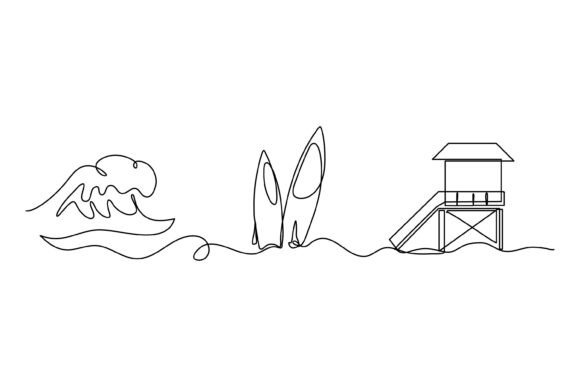
The Art of Continuity: Exploring Single Line Designs of Waves, Surfboards, and Lifeguard Towers
In the vast landscape of digital art and graphic design, few styles capture the essence of minimalism as effectively as the continuous line drawing. This technique, where a single unbroken stroke defines the entire subject, has gained immense popularity in recent years for its elegance, simplicity, and profound visual impact. When applied to iconic coastal imagery—specifically a wave, a surfboard, and a lifeguard tower—the result is a striking decorative element that speaks volumes about motion, safety, and the spirit of the ocean. Whether you are a designer looking for high-quality assets or an enthusiast appreciating the aesthetic, understanding the nuances of this style is essential.
This article delves into the world of continuous line design, exploring how these specific elements are rendered on a white background, why they matter in modern creativity, and what formats like EPS, SVG, and JPG offer to your projects.
Understanding the Continuous Line Technique
At its core, continuous line drawing is an artistic method where the artist does not lift their pen from the paper (or stylus from the tablet) until the image is complete. It requires a fluid understanding of form, perspective, and flow. Unlike traditional sketching, which relies on shading, cross-hatching, or multiple distinct strokes to build depth, the continuous line relies on the path itself to suggest volume and texture.
When we apply this to the theme of the ocean, the technique becomes particularly potent. A wave is inherently dynamic; it is a force of nature defined by curves and movement. A surfboard is a sleek vessel designed to cut through water. A lifeguard tower stands as a static sentinel against the horizon. Capturing all three in a single, unbroken line creates a narrative connection between the danger, the sport, and the safety of the beach environment.
Why White Backgrounds Matter
The decision to render these designs on a stark white background is not merely an aesthetic choice; it is a functional one. In graphic design, negative space is just as important as the positive space occupied by the lines. A white background ensures that the single black (or colored) line remains the undisputed focal point. It allows the viewer's eye to follow the intricate path without distraction, emphasizing the skill involved in connecting the disparate elements of a wave, a board, and a tower into a cohesive whole.
The Iconography of the Coast: Wave, Surfboard, and Tower
To truly appreciate a continuous line design featuring these three elements, one must understand the symbolic weight each carries. Together, they tell the story of the beach experience.
- The Wave: Represents energy, challenge, and the raw power of nature. In a single-line drawing, the curve of the wave often serves as the foundational stroke, setting the rhythm for the rest of the composition.
- The Surfboard: Symbolizes human interaction with nature, skill, and recreation. The board usually bridges the gap between the organic chaos of the wave and the structured geometry of the tower.
- The Lifeguard Tower: Stands for vigilance, community safety, and order. Its geometric structure provides a necessary contrast to the fluid lines of the water and the board.
When combined, these elements create a balanced composition. The continuous line forces the artist to find a logical flow from the crashing water to the floating board and finally to the stationary tower. This flow mimics the actual experience of a day at the beach: watching the waves, seeing the surfers, and noticing the safety structures nearby.
Practical Relevance in Modern Design
Why is this specific type of illustration so relevant today? The answer lies in the shift towards clean, versatile, and scalable graphics in both digital and print media. Minimalist aesthetics dominate modern branding, web design, and social media content because they load faster, look better on small screens, and convey messages instantly.
Applications in Business and Branding
For businesses related to tourism, sports apparel, coastal real estate, or summer events, a continuous line design of a wave, surfboard, and lifeguard tower offers a unique branding opportunity. It suggests a brand that values clarity, sophistication, and a deep connection to the coastal lifestyle. Imagine this design used as a logo for a beach resort, a watermark on a sunscreen bottle, or a central motif on a t-shirt collection.
The versatility of the single-line style means it can be adapted to various color palettes while maintaining its integrity. It fits seamlessly into "flat design" trends, making it ideal for app icons, website headers, and presentation slides.
Educational and Decorative Uses
Beyond commercial applications, these designs serve educational purposes. They can be used in geography or environmental science materials to illustrate coastal ecosystems simply yet effectively. Furthermore, as a decorative element, such artwork transforms interior spaces. A framed print of a continuous line surf scene adds a touch of modern elegance to a home office or living room, evoking a sense of calm and wanderlust without cluttering the visual field.
Technical Formats: EPS, SVG, and JPG
When acquiring or creating a continuous line design, the file format is critical to its utility. High-quality resources typically provide the artwork in three primary formats: EPS, SVG, and JPG. Each serves a distinct purpose in the workflow of a designer or creator.
- EPS (Encapsulated PostScript): This is a vector format widely used in professional printing. If you plan to use the wave and surfboard design on large banners, billboards, or high-resolution merchandise, EPS is the gold standard. It ensures that the lines remain crisp regardless of how much the image is scaled up.
- SVG (Scalable Vector Graphics): Ideal for the web, SVG files are lightweight and resolution-independent. They allow the continuous line to render perfectly on any screen size, from a smartphone to a 4K monitor. Additionally, SVG code can be manipulated directly by developers to add interactivity or animation, such as making the line draw itself across the screen.
- JPG (Joint Photographic Experts Group): While a raster format, JPG is universally compatible. It is perfect for quick previews, social media posts, or embedding in documents where vector editing is not required. However, unlike EPS and SVG, enlarging a JPG beyond its original resolution will result in pixelation.
Having access to all three formats ensures that the asset is future-proof. You can use the JPG for a quick Instagram story, the SVG for your website's navigation bar, and the EPS for printing business cards or promotional flyers.
Common Misunderstandings About Minimalist Art
A common assumption among beginners is that simple line drawings are easy to create. In reality, a successful continuous line design requires significant planning and precision. There is no room for error; if the line breaks, the illusion of continuity is lost. The artist must visualize the entire path before starting, knowing exactly how to transition from the curve of a wave to the straight edge of a lifeguard tower without lifting the tool.
Another misconception is that minimalist designs lack detail or emotion. On the contrary, the constraint of a single line often forces the artist to distill the subject down to its most emotional and recognizable features. The resulting image often resonates more deeply with viewers because it invites them to fill in the gaps with their own imagination, creating a more personal connection to the artwork.
Building a Broader Understanding
As we navigate an increasingly complex digital world, the appeal of the continuous line design lies in its ability to bring order and beauty to chaos. The combination of a wave, a surfboard, and a lifeguard tower encapsulates the duality of the ocean: its thrilling unpredictability and our structured efforts to enjoy it safely.
Whether you are using these designs for a creative project, a business rebrand, or simply to decorate your space, understanding the technical and artistic principles behind them enhances your appreciation. By choosing high-quality vector files like EPS and SVG, you ensure that the art remains sharp and versatile, ready to adapt to the evolving needs of modern design.
Ultimately, the continuous line is more than just a drawing technique; it is a philosophy of efficiency and elegance. It reminds us that sometimes, the most powerful message is delivered not through complexity, but through a single, unbroken thought.